

We all want to be good parents. We want to be close to our children and we want them to develop into good people. We have mental pictures of loving, peaceful, happy families extending into eternity.
But the toast burns, milk spills, chores get forgotten, squabbles break out. Children act childishly.
And we parents get tired, distracted, frustrated, and overwhelmed. Life burdens us.
In spite of our noble aspirations, we spend a lot of time being irritated with our children—sometimes downright angry. Family scripture study devolves into sibling spats. Family prayers either involve chaos or they are neglected. Sibs fight. Children act irresponsibly.
We don’t know whether to be angry with the children or disgusted with ourselves. We slump into parental despair. It seems that all is not right in our families.
Unless we have the heavenly perspective. Terryl and Fiona Givens have focused us on the God who is the perfect model of parenting.
One comfort is to be found in a God whose power is in His magnanimity as well as His wisdom. These two traits mean that His divine energies are spent not in precluding chaos but in reordering it, not in preventing suffering but in alchemizing it, not in disallowing error but in transmuting it into goodness. . . . If God can transform cosmic entropy and malice alike into fire that purifies rather than destroys, how much more can He do this with the actions of well-intentioned but less-than-perfect [parents].
pp. 78-79, Terryl & Fiona Givens, The Crucible of Doubt, 2014, Deseret Book
God can transform our parenting crises into growth for us and for our children. If we draw Him into our parenting.
Life is supposed to be hard. Parenting is supposed to test us to see whether failed efforts will lead to better attempts. God wants to see if we will learn and keep trying. He wants us to learn the power of His principles. He wants us to discover that we cannot be the parents we should be without His heavenly help.
Ultimately, He wants us to become partners with Him. Our imperfect but wise and persistent efforts on earth will yield not only faith-filled children on earth but reformed and refined character in our own souls. That is God’s purpose. That is godly parenting. This series of articles describes the four foundational principles of parenting. It is intended for earnest and imperfect parents who would like to become godly parents.
We rarely recognize the eternal significance of parenting in God’s plan. Parenting is God’s central task: “He doeth NOT ANYTHING save it be for the benefit of the world” (2 Nephi 26:24, emphasis added). Parenthood is also His core identity; first and foremost, He calls Himself Father.
Earthly parenting is the place where we learn the vital lessons to prepare us to join Him in His work. It is, above all else, an apprenticeship for godliness.
Research has shown that LDS people have distinctive beliefs about parenting—but their parenting is like everybody else’s. What a shame that our extraordinary understanding of God’s plan and character have not informed and enriched our way of caring for our children! What a tragedy that our parenting light doesn’t shine brighter.
What are the distinctive doctrines that could make our parenting more heaven-like? What are the principles that God models in His own parenting that should be the core of ours? How can the principles be translated into practices that strengthen our families?
Benefiting from Science and Scripture
God has always had the best answers to all questions and challenges. Yet we rarely mine God’s truth for all its riches.
I believe that science can be combined with God’s truths to help us find powerful answers especially in the area of parenting. God’s principles of parenting are surprisingly consistent with the great discoveries of research.
A national project reviewed decades of research and released a report called the National Extension Parent Education Model which identified six principles as foundational to good parenting (Smith, Cudaback, Goddard, & Myers-Walls, 1994). I would like to take four of those principles—the ones I believe are most essential—and enrich them with spiritual perspectives to form a Model for Godly Parenting.
In this article I will introduce each of these four principles. I will use the analogy of building a house to help us envision the key ideas for raising children. Then future articles will be dedicated to looking at each principle in greater detail and discussing how to apply each of them to making your parenting more godly.
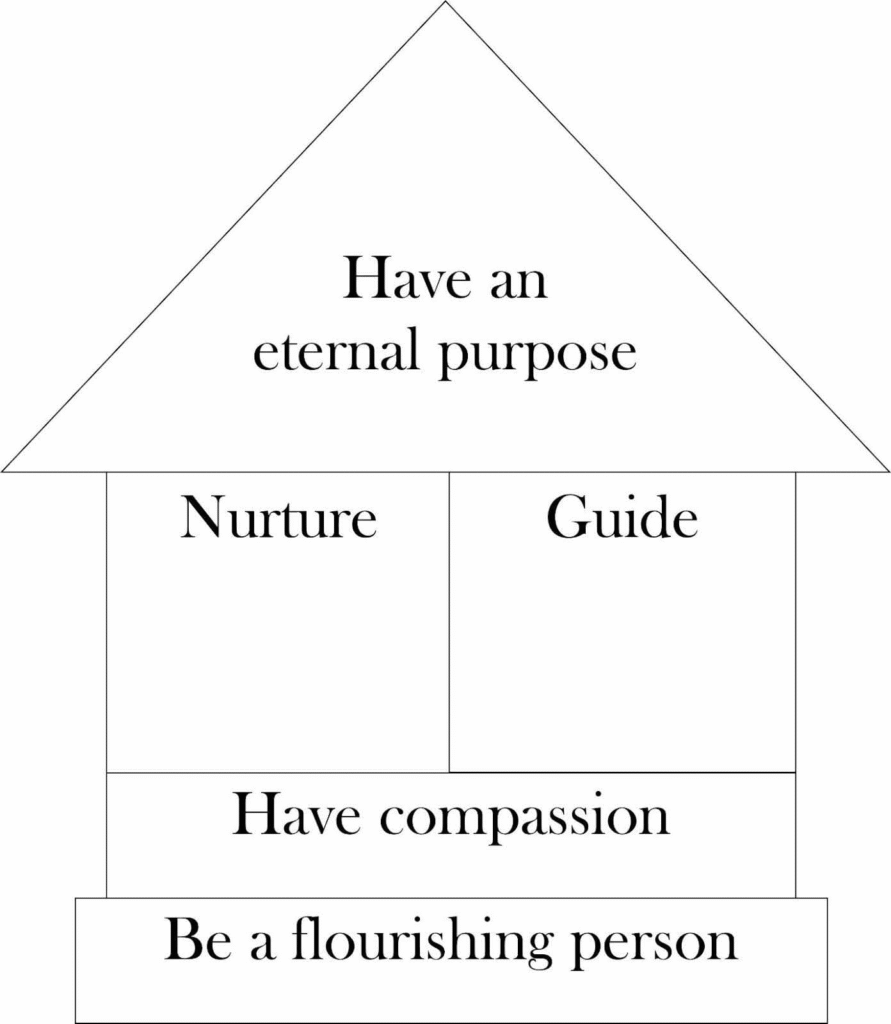
The Footings: The Flourishing Parent
At the very base of any substantial structure are the footings or footers. This substantial course of concrete is generally wider than the foundation and assures that the foundation (and the whole structure) will not settle and crack. The integrity of the structure depends on the strength and the solidity of those footings.
What are the footings of parenting? What does the entire structure rest on? I believe that the footings are the state of mind and quality of character of the parent. Parenting scholars often speak of the concept of “parent care for self”, meaning that a parent must be a healthy, functioning human in order to be a good parent. A miserable, unhappy person is not likely to be an excellent parent.
Further, when we are not built on the Rock, the storms of parenting will wash us away. When we are built upon the Rock of our Redeemer, we are solid (Matthew 7:24).
The Gospel of Jesus Christ suggests that we must be converted before we can strengthen others (Luke 22:32). A corrupt tree cannot bring forth good fruit (3 Nephi 14:17). The same principle applies to parenting. A dead tree trunk cannot nourish the branches. A troubled, hostile, bitter parent will find it difficult or impossible to deliver life-sustaining truth and goodness to children. A person who is spiritually alive and growing is more likely to be a flourishing parent, capable of nourishing children and helping them thrive.
Of course the Gospel prescribes very specific actions if we are to be flourishing people. In fact, God provides a surprisingly tart directive to parents
Teach parents that they must repent and be baptized, and humble themselves as their little children, and they shall all be saved with their little children. (Moroni 8:10)
The foundational principles of faith, repentance, and covenant-making have special relevance to parenting. These are the principles of spiritual growth. We must be earnest about our relationship with God if we are to be the best parents.
The Foundation: Compassion
Built on the footings of a great structure is the foundation. The scholarly model of parenting recommends “Understanding” as the foundation of parenting. This concept encompasses everything from understanding normal development to understanding a child’s unique temperament and circumstances. Understanding is vitally important.
God prescribes something even richer than understanding: Compassion. While understanding entails a knowledge of development and personality, compassion involves being “touched with the feeling of our [children’s] infirmities” (Hebrews 4:15). Compassion goes beyond understanding the child and entails a readiness to act in the interest of the child. This is best done when we see the world through the eyes of the child. Compassion is the offering of our whole souls to experience the lives of other people.
Compassion is exactly what Jesus did as part of the atonement. Not only did He bear the burden of our sins, but He also bore our infirmities so that His compassion would be fully informed (Alma 7:11-12). We can NEVER rightly say to Him: “You just don’t understand!” He does understand. He bore every pain, discomfort, and disappointment any human ever suffered so that He would have perfect compassion.
Jesus invites us to have compassion for our children. I believe that our development of compassion is absolutely foundational to good parenting. In the absence of compassion, we cannot respond to children’s challenges in ways that help them learn and grow.
The Body of the House: Nurture and Guidance
The body of the house involves two companion processes. In the scientific community we call them nurture and guidance. God calls them something similar in scripture. “And, ye fathers, provoke not your children to wrath: but bring them up in the nurture and admonition of the Lord” (Ephesians 6:4).
I believe that God chose the words “nurture” and “admonition” very deliberately. It is exactly those words that Enos uses in describing the godly parenting that he received (Enos 1:1).
Nurture is any behavior that the child experiences as warm, caring, and supportive. The key is how the child experiences the behavior. In other words, all the parental “I love you’s” in the world do not constitute nurture unless the child feels loved.
This is where wise guidance provides the perfect balance for gracious nurturing. Children must not only be loved but also learn the law of the harvest. “Be not deceived; God is not mocked: for whatsoever a man soweth, that shall he also reap” (Galatians 6:7). Children must be taught eternal principles and the consequences of disregarding them.
The reality of mortal parenting is that children won’t always feel loved or loving when they are learning the law of the harvest. Sometimes we don’t feel loved by God even though His love never fails. Yet we can create a bond that is stronger than the cords of death (D&C 121:44) while helping children learn to honor the principles of eternal growth: “I, the Lord, am bound when ye do what I say; but when ye do not what I say, ye have no promise” (D&C 82:10).
We can best teach children when we ourselves are striving to honor the laws of God. Then we strive to teach our children the very principles that guide our lives.
The Roof: Eternal Purpose
Our objective is not merely to get our children through mortality in a way that keeps them out of hell in eternity. Those of us who have the fullness of the Gospel have loftier ambitions. We are preparing our children to do the work that God does and, in the process, we are preparing ourselves to do as God does and be as God is. YIKES! That is an exalted objective! In fact it is fully impossible for mere humans—unless we get divine help. When we understand God’s eternal purposes, we are humbled. When we earnestly seek heavenly counsel, we are taught from on high, including how to more effectively, compassionately, and wisely parent our children.
In the following articles, we will walk through each of these principles in more detail including the specific processes that help us succeed at this sacred and blessed opportunity of rearing children. I invite you to join me for that journey.
Reference: Smith, C. A., Cudaback, D., Goddard, H. W., & Myers-Walls, J. (1994). The National Extension Parent Education Model. Manhattan, KS: Kansas State University.
